The investigation also found missing safety information for parents and much higher lead levels than Kroger reported for its own products.
When you buy food for your baby, you should be able to trust that the grocery store selling it has done everything it can to ensure it’s safe for your child to eat. You shouldn’t have to hire a laboratory, research food safety laws, or spend hours tracking down test results just to know what’s in your baby’s food.
But our new investigation finds that even if you did all that, you still might not be able to know the food you bring home to your baby is safe. The report raises serious questions about whether Harris Teeter and its parent company, Kroger, are doing enough to protect the families who shop at their stores.
In July and August 2026, the Center for Responsible Food Business (CRFB) hired an independent, accredited laboratory to purchase and test baby food from 11 Harris Teeter stores in Maryland and Virginia. The laboratory analyzed 178 samples representing 72 products from 16 brands for lead, arsenic, cadmium, and mercury.
The results should concern any parent who shops at Harris Teeter –– or any Kroger-owned store across the country:
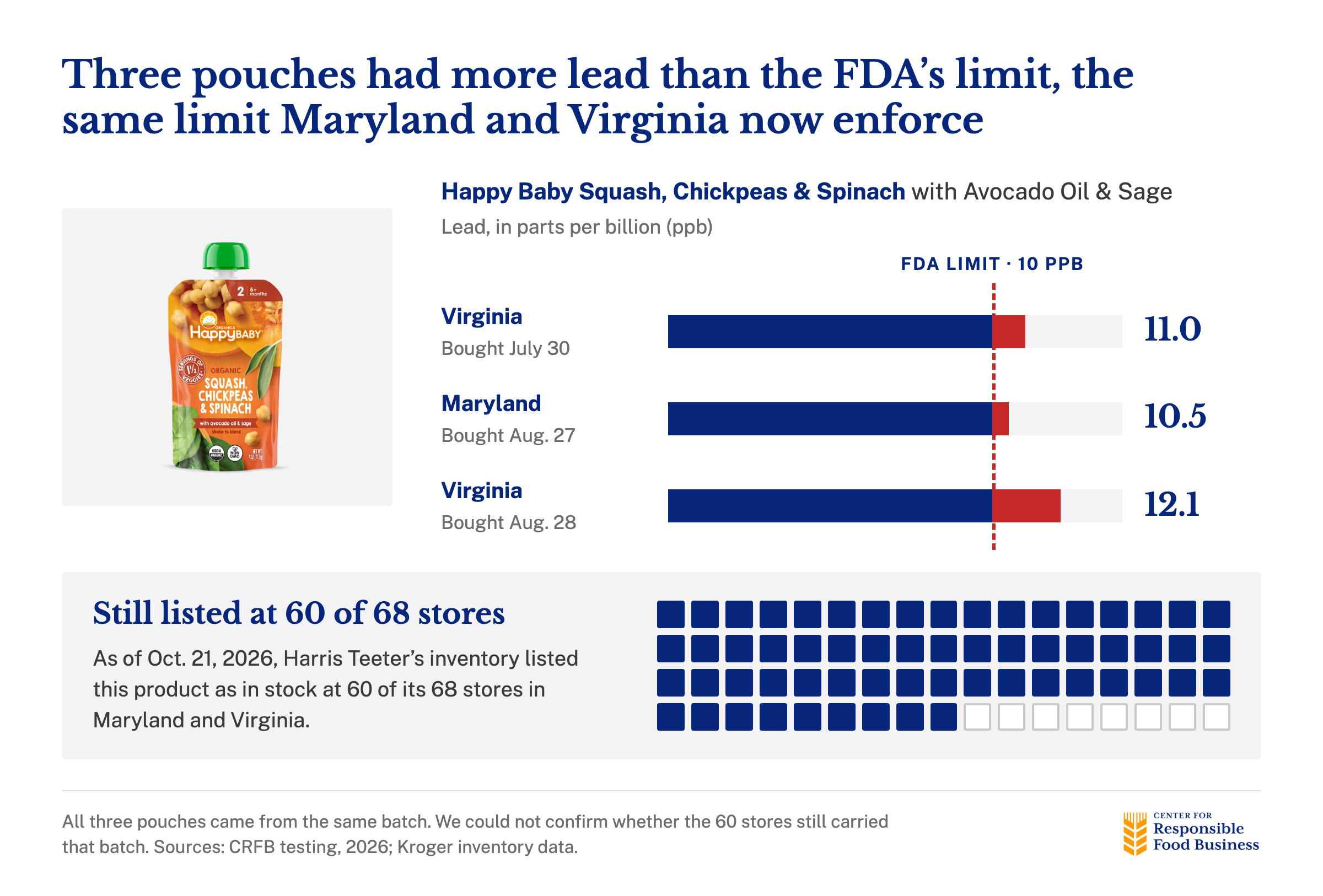
Three pouches of Happy Baby Squash, Chickpeas & Spinach contained 10.5, 11.0, and 12.1 parts per billion (ppb) of lead, exceeding the FDA's action level of 10 ppb for that type of baby food and potentially violating state laws.
Lead, cadmium, arsenic, and/or mercury were found in every sample tested. 99% of samples contained two or more toxic metals.
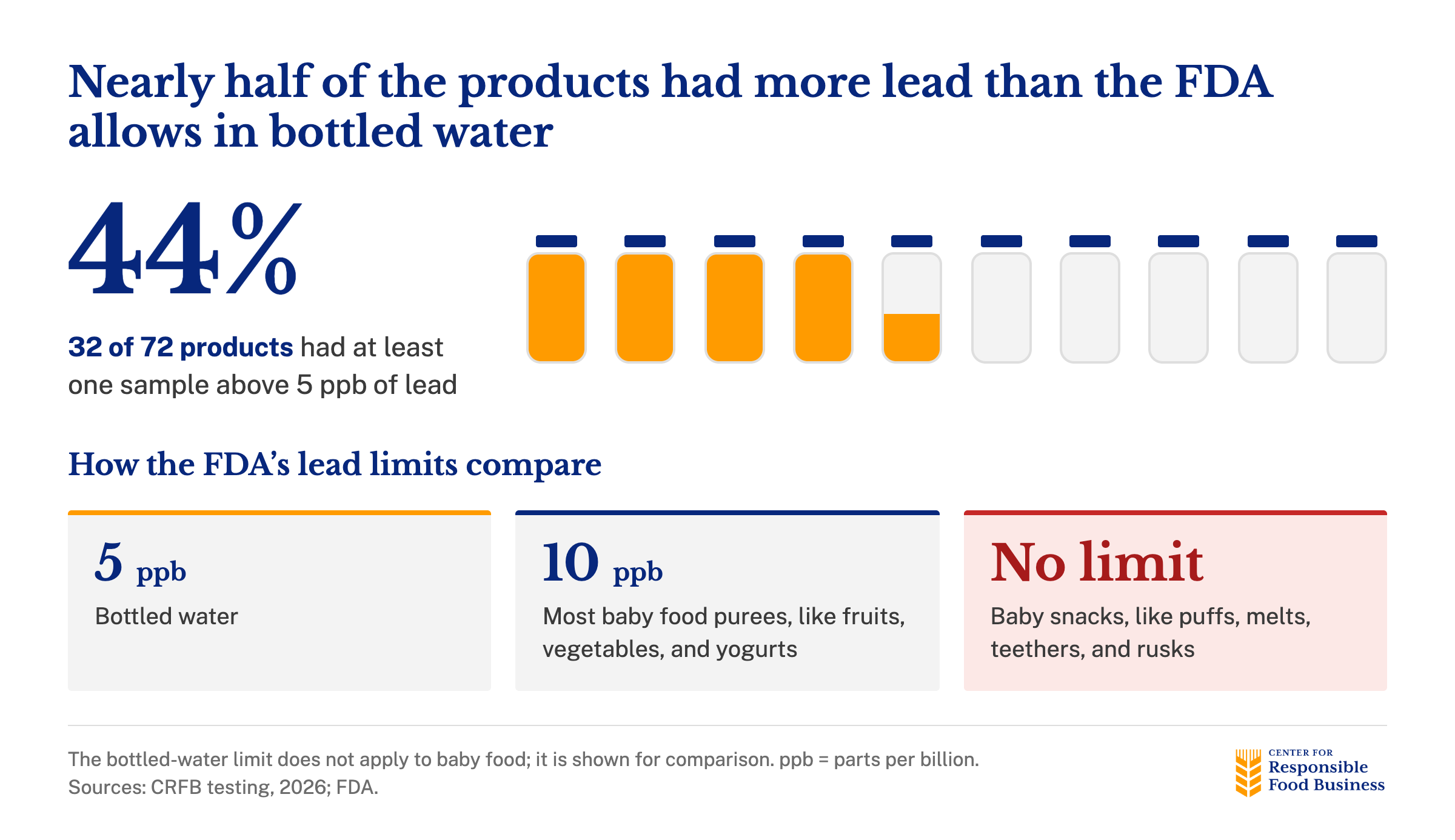
Nearly half of samples contained more lead than the FDA allows in bottled water.
Kroger's own baby snacks contained substantially more lead than the company reported.
Some baby foods exceeded California's daily lead exposure benchmark in a single serving.
Read the report: Toxic Heavy Metals in Baby Food Sold at Harris Teeter
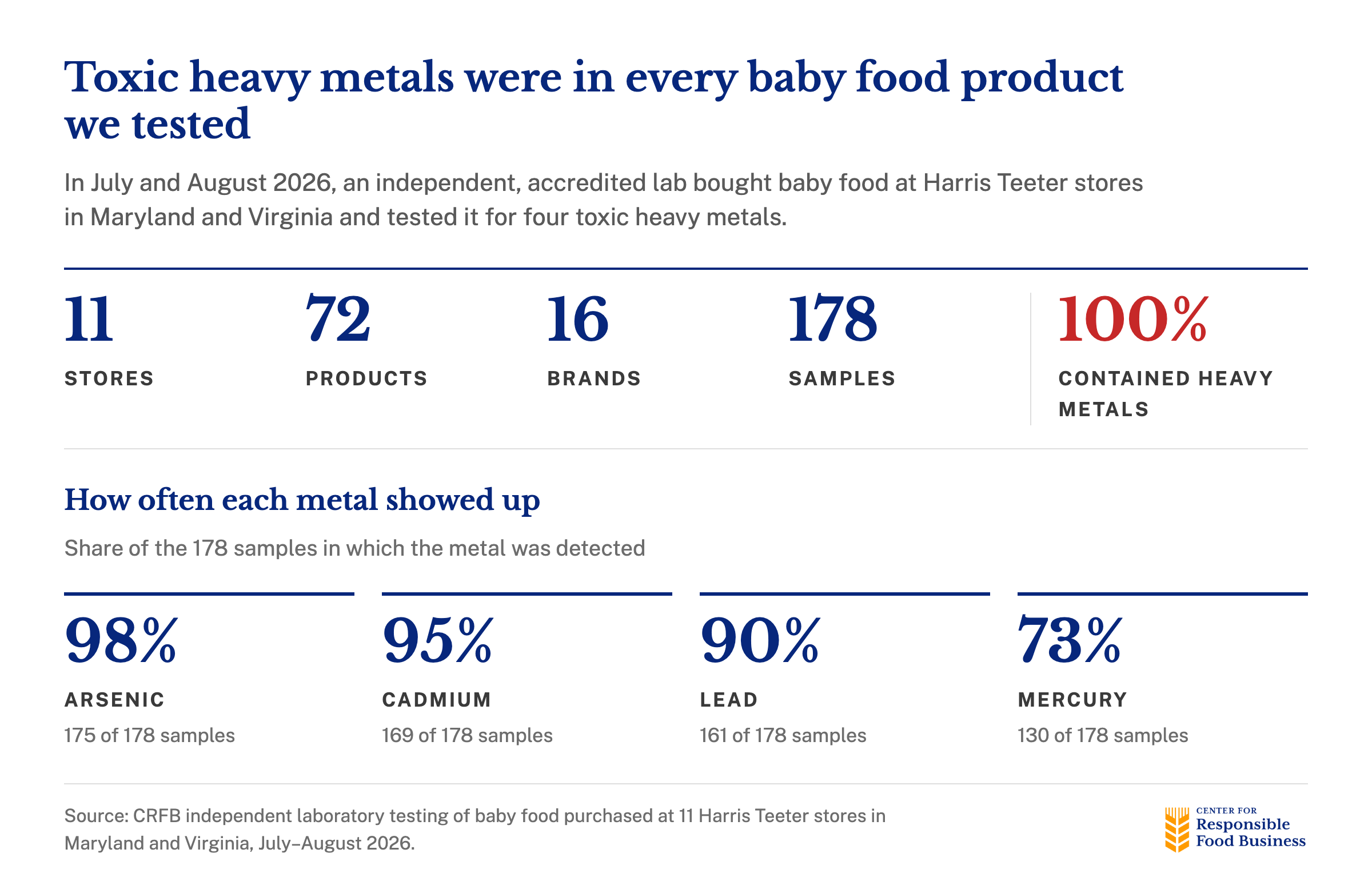
Harris Teeter sold baby food with alarming amounts of heavy metals, including products with lead levels over two states’ legal limits
Across the board, our investigation found concerning levels of heavy metals in baby food sold at Harris Teeter. Every single product our laboratory tested contained heavy metals, and nearly half of the products tested contained lead above the FDA’s limit for bottled water. Of course, the bottled water limit does not apply to baby food, but the comparison is troubling nonetheless.
Three products contained lead levels that exceeded new limits set by Maryland and Virginia state laws, though a loophole in the laws concerning manufacturing and stocking dates may have made those sales legal.
Those three products were pouches of Happy Baby Squash, Chickpeas & Spinach with Avocado Oil & Sage, which contained 10.5, 11.0, and 12.1 parts per billion (ppb) of lead. The FDA’s “action level” for that type of baby food is 10 ppb.
It’s important to note that the FDA’s “action levels,” aren’t a guarantee of safety. The agency sets them partly based on what manufacturers say they can achieve, rather than what’s actually safest for babies. And while they aren’t binding federal limits, Maryland and Virginia have turned them into legally enforceable standards for certain baby foods, though both laws have loopholes.
The manufacturing date may change whether Harris Teeter broke the law. It doesn't change how much lead a baby consumes.
This isn’t just about products purchased months ago. As of late October, Harris Teeter’s own inventory system listed the same product as available at 60 of the 68 stores we checked across Maryland and Virginia. We could not confirm whether those stores still carried the affected production batch.
Harris Teeter should not need a law to tell it to keep products exceeding FDA lead levels off its shelves.
Many More Products Raised Concerns, Including Foods Without Legal Limits
Some of the highest lead concentrations our investigation found were in baby snacks, which aren’t covered by the FDA's lead action levels. One sample of Beech-Nut Pear, Mango & Spinach Yogurt Melties with Probiotics contained 27.6 parts per billion (ppb) of lead, nearly three times the FDA’s action level of 10 ppb for most baby food purees. Thirteen of the 69 snack samples tested contained more than 10 ppb of lead.
Although the FDA’s guidelines don’t cover snacks, there is no evidence that heavy metals in snack foods are any less dangerous to babies and young children.
The amount of lead a baby consumes in a single serving also matters. For eight products (23 samples), a single serving contained more lead than California’s benchmark for an entire day’s exposure. One jar of Beech-Nut Organics Sweet Potato contained 1.55 micrograms of lead, more than three times that benchmark. Although that threshold is not a legal limit for baby food, the comparison helps put the exposure into perspective.
Lead wasn’t the only concern. Certain Happy Baby rice-based teethers contained enough inorganic arsenic in a single serving to account for approximately 75 to 90 percent of the EPA's daily reference dose for a 22-pound child. Eight samples from three baby food purees also exceeded the FDA’s newly proposed cadmium action levels. And one sample of Serenity Kids Salmon Teriyaki contained 5.77 ppb of mercury, nearly three times the FDA’s limit for bottled water, although that limit does not apply to baby food.
These comparisons don’t establish that a single serving will harm a child. But they raise serious questions about why Harris Teeter continues selling products with elevated concentrations of toxic metals, particularly when so many baby foods fall outside the FDA’s limited standards.
Kroger’s own baby snacks had more than three times the lead the company reported in its own test results
We tested Kroger’s own Simple Truth Organic Apple & Sweet Potato Rice Rusks, a teething snack that has been the subject of a federal lawsuit over alleged heavy metal contamination since 2022.
Two packages contained 11.1 and 12.3 ppb of lead. But Kroger’s published results for the same production batches reported just 3.65 and 3.18 ppb.
That means our independent laboratory found more than three times as much lead as Kroger reported for the same batches of its own products.
Different samples from the same batch can produce different results, but discrepancies this large deserve an explanation. Kroger should tell parents why its published numbers were so much lower than what our laboratory found.
Parents can’t always find out what’s in the food they’re buying
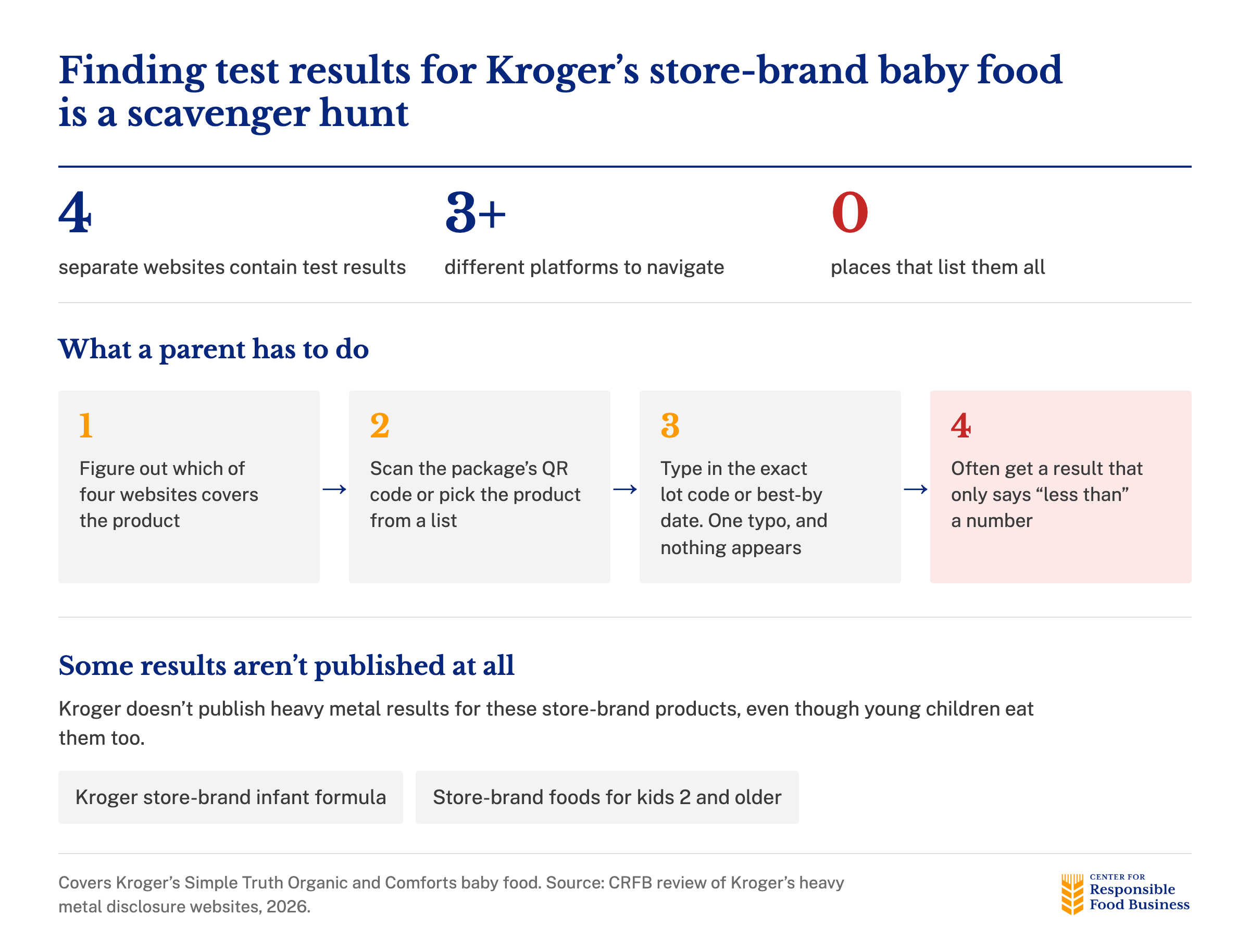
New laws in Maryland and Virginia require manufacturers to test baby foods and publish results so parents can check what they’re purchasing, but our investigation found serious transparency problems.
Two products with some of the highest lead concentrations in our study had no published test results that parents could reliably match to the packages on store shelves. We’ve asked regulators to investigate whether those products comply with state disclosure requirements.
Kroger makes matters worse with its own confusing system. Heavy metal testing results for its store brands (Simple Truth Organic and Comforts) are spread across four different, confusing websites. Some require parents to scan a QR code, enter exact dates, or navigate multiple steps just to find the information they're looking for.
Even then, many results simply say “less than” a particular concentration, leaving parents unable to determine how much metal was really found.
Consumer Reports raised concerns about Kroger’s disclosure practices back in March 2025. More than a year later, parents are still facing these obstacles.
Kroger also does not publish results for its store-brand infant formulas or foods marketed to children ages two and older, despite the fact that there is no evidence that heavy metals in these foods are any less toxic to children.
Parents deserve better than a scavenger hunt for basic food safety information.
Harris Teeter and Kroger have the power to protect children. Why aren’t they doing more?
Kroger doesn’t manufacture most of the baby food on its shelves. But that doesn’t absolve the company of responsibility.
Retailers decide which products to carry, what standards their suppliers must meet, and when products should be removed. Maryland and Virginia’s laws recognize that responsibility by holding retailers accountable for selling covered baby foods above FDA limits.
Kroger is one of America's largest grocery companies. In its own 2025 Responsible Business Report, the company describes food safety as its highest priority and details extensive systems for testing products and overseeing suppliers.
So why aren’t those safeguards doing more to address toxic metals in baby food?
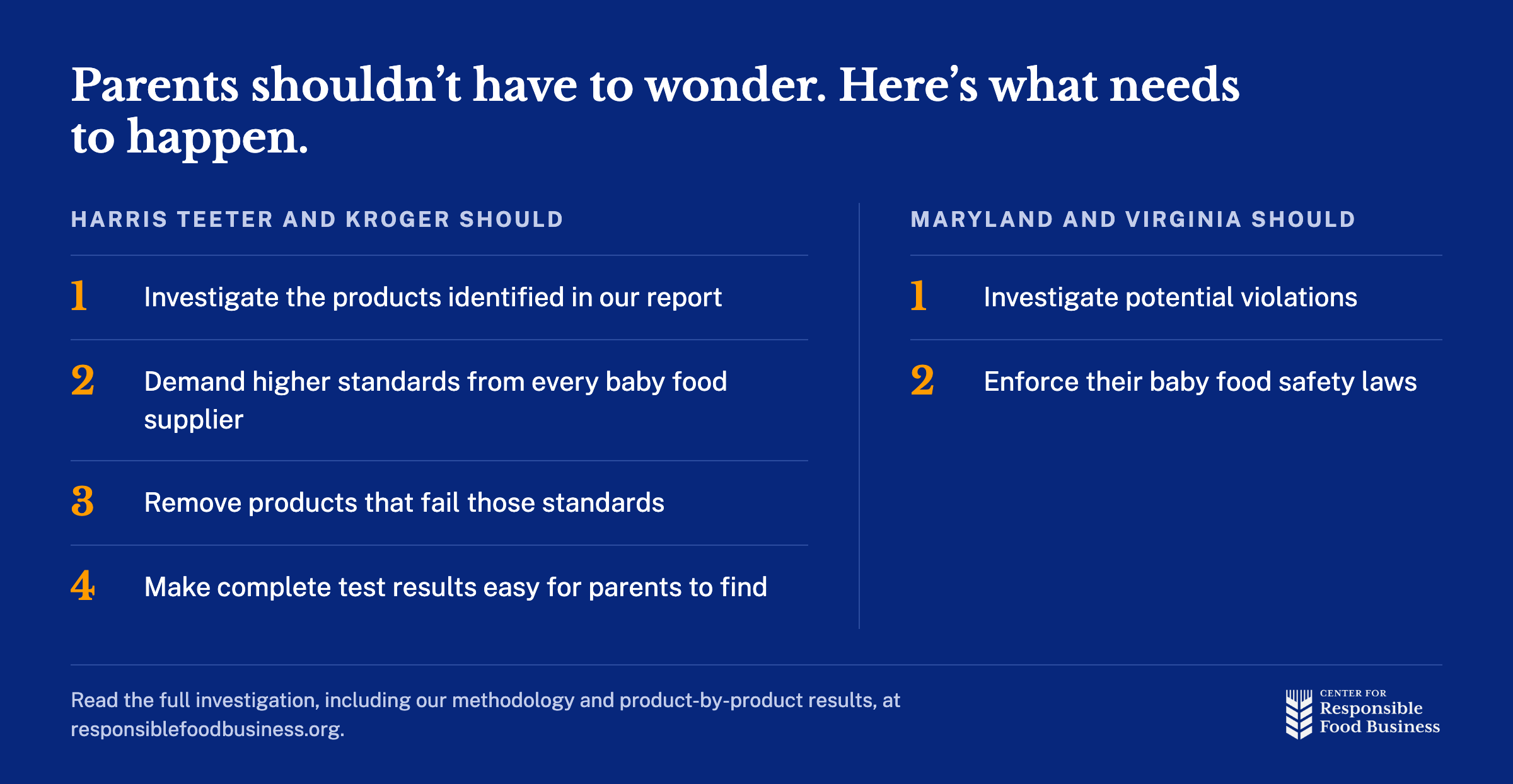
We’re calling on Harris Teeter and Kroger to investigate the products identified in our report, demand higher standards from every baby food supplier, remove products that fail those standards, and make complete testing results easy for parents to find. We’re also calling on Maryland and Virginia to investigate potential violations and enforce their laws.
Parents shouldn’t have to wonder whether their grocery store is doing everything reasonably possible to protect their children. They should be able to expect it.
Harris Teeter and Kroger have the resources, purchasing power, and responsibility to demand better. Until they demonstrate they’re taking these concerns seriously, parents have every reason to question whether these companies deserve their business.